
It is not you, it is them
Lately, anytime I open LinkedIn there’s either news of another mass layoff, or someone I knew personally is suddenly wearing that green “Open to Work” banner, the kind you wouldn’t wish on your worst enemy in this market.
The sad part is how indiscriminate it feels. Thoroughly professional, smart, dependable, high-IQ people seem to be affected just as much as anyone.
Having gone through a layoff myself, I know how it feels. The imposter syndrome rears its ugly head, and you spend your nights thinking about where you went wrong.
So let me say it plainly, for anyone sitting in that place right now. It is not you. It is them. The explanation that gets stapled to these layoffs, that the market corrected, that AI made you redundant, that you should have adapted faster, doesn’t hold up once you look at how the industry actually got here.
A disclaimer before I go further. I don’t claim to be an expert, and I’m not trying to accuse anyone in particular. I’m your run-of-the-mill worker, laid off like a lot of others, trying to show some solidarity with people in the tech fraternity. What follows is the way the last decade looks to me from the inside.
The bloat nobody asked for
The layoffs look to me far more like a correction for years of massive bloat and speculation in the industry than a response to the arrival of AI. AI is the headline. It is not the cause.
And here’s the part worth sitting with: no worker asked for that bloat. Very few people in the tech workforce ever benefited from bloated services directly. The closest most of us got to a benefit was indirect. All that money sloshing around probably raised the salary bar overall. That’s it. The bloat was a decision made well above the people who are now being asked to pay for it.
Hiring as a moat
A lot of the hiring in big tech wasn’t about getting work done. It was about denying the work to someone else.
The pattern is hard to miss. Companies over-hired to manufacture an artificial shortage of engineers, partly to keep competitors from getting their hands on the best talent. A former Meta employee described being hoarded like Pokémon cards, hired and then handed nothing real to do. Keith Rabois, who built teams at PayPal and Square, has said Google over-hired engineers to do “fake work” precisely so rivals couldn’t have them.
This isn’t even the first time the talent market got engineered from the top. A decade earlier, Apple, Google, Intel, and Adobe were caught secretly agreeing not to poach each other’s staff to hold salaries down, and paid $415 million to settle it. When the people who run the market treat hiring as a lever to pull, it stops being tied to a specific problem that needs a specific skill. You hire to hold the talent, not to deploy it.
Follow that for a few years and you get a strange situation. For a considerable stretch, the most expensive hiring wasn’t for a highly specialized skillset, and it still resulted in very well-paid jobs. The price went up while the link between the job and the work got thinner.
The interview became a profession of its own
To manage all this hiring, big tech built an evaluation system that had almost no link to the actual work. Over time it became a specialized skill in its own right. Tech interviews turned into a niche economy whose entire purpose is to get you hired. Courses, grinding platforms, a whole industry sitting on top of the gate.
Tech might be the only field where the workforce trains heavily in skills it rarely uses in real life. Once you notice that, the consequence isn’t unreasonable to draw: every hour spent on interview prep is an hour not spent on the skills the job actually requires.
This next bit is anecdotal, but I think that skill attrition shows up in the steadily declining quality of the software we all use. Software engineering has plenty of de facto standards. Most of them are largely not followed.
Solutions looking for a problem
It’s worth stressing that not all software is the same. The skills to build an operating system, stock-market software, a game engine, and medical software are not interchangeable. Ideally we’d have engineers who are deeply specialized in their domain.
Instead we mostly have engineers who are highly trained in certain tools. It can feel like people are walking around with a solution, looking for a problem to apply it to, rather than starting from a problem and reaching for whatever skill solves it.
Built for investors, not customers
The companies themselves have the same problem one level up. Most are investor-driven rather than customer-driven. Even when a company starts out trying to solve a real problem, it ends up sustained by investors. And investors want value for their money, which is not always the same thing as value for the customer.
So the incentive tilts toward performative progress instead of a real boost in productivity. It has become normal for a company to operate at a loss and juice its numbers by whatever means necessary to reach the next round of funding. Somehow this gets treated as acceptable by all the big players, even though it’s detached from how real businesses work, where profitability is the point and comes from customer success, good support, and efficiency.
Put it all together: the hiring, the evaluation, the way these companies sustain themselves. From there you can largely trace the ins and outs of most tech companies back to speculation and performative assets. You can essentially call it a bubble.
Then someone dropped an LLM into it
So what happens when something like an LLM lands on an industry shaped like that?
The band-aids come off. All the small things quietly holding together an already broken and fragile social contract stop holding.
I’ll be clear: LLMs are genuinely interesting, and they’ve changed how we work. No argument there. But they’re also the ultimate speculative asset, the one that trumps every other piece of speculation in the industry. And if your business was already built on the potential of something rather than on actually doing something, pivoting to the next shiny thing is easy. It’s like slapping AI on a shoe company so it can sell chips. And that’s not a hypothetical. Allbirds, the sneaker brand, just sold off its footwear business and rebranded as an AI compute company, planning to lease out GPUs, and the stock jumped around 600% on the announcement alone.
The questions nobody is answering
There are a lot of fundamental questions around AI and frontier models that the rush conveniently skips:
- The sustainability of the data centers it all runs on.
- The impact on wider employment. If everyone gets replaced, who pays the taxes, and who exactly do these businesses sell to?
- The true cost of a token, once the subsidies stop.
- The money. More than a trillion dollars has already gone into the AI build-out, and the spending is headed well past 1.3 trillion. For all of it, we still haven’t seen a real breakthrough in medicine, law, the environment, or poverty. AI still hasn’t delivered the new medicines it keeps promising. You have to wonder why we’re collectively putting all our eggs in one basket, on a problem that might not even be the important one, instead of solving real problems directly.
It is not you
Despite all of the above, businesses keep chasing the next thing, and it’s reckless at the very best. There’s almost no method to the madness.
And through all of it, the person who got the layoff email is the one who actually did the work. You didn’t ask for the bloat. You didn’t design the interview gauntlet. You didn’t decide to run the company for investors instead of customers, or bet everything on a pivot.
So if you’re sitting there wondering what you did wrong, I’d gently push back on the question. It is not you. It is them.
We’re just fragmented
Still, none of this is a verdict on the people. The system is bent. The people in it, mostly, are not. There are genuinely good, generous people all through this industry, and plenty of them are doing just fine. The trouble is that we’re scattered. Heads down, busy, easy to pick off one at a time when something goes wrong.
Here is what I mean. After I posted about my own layoff, a former colleague reached out. We’d worked at the same place but on different teams, never closely. This is what they sent:
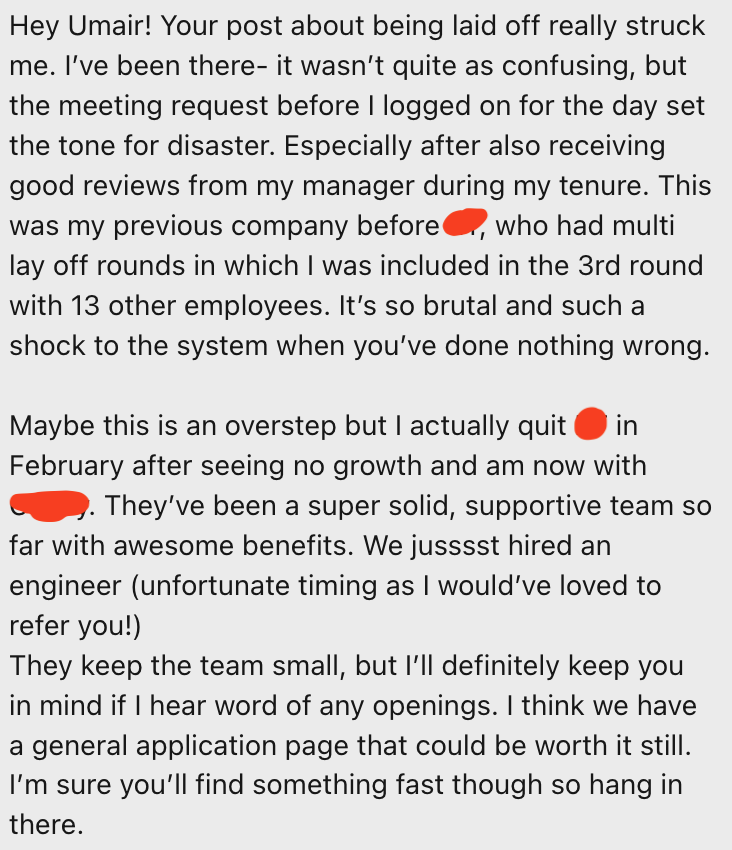
There was nothing in it for them. Someone I’d barely worked with, from another team entirely, taking the time to check in and offer what they could. That happens far more often than the layoff headlines would have you believe.
So if you are in the green-banner phase right now, hold onto that part too. The reality I described is real, but it is not the whole picture. The good people are still out there, and they are still looking out for each other. We just have to find each other more often than we do.
And in the words of a former colleague who made my week a little lighter: hang in there.